 NATHAN LEFEUVRE
Round jet: self-preservation confirmed at every scale
A look back at our Journal of Fluid Mechanics paper (2016): on the axis of a round jet, theory and hot-wire data show complete self-preservation.
In 2016, I co-authored this Journal of Fluid Mechanics paper with Lyazid Djenidi, Robert Antonia (University of Newcastle, Australia) and Jean Lemay (Université Laval, Canada). The topic: showing that, far from the nozzle, turbulence on the axis of a round jet is self-preserving at every scale, and deriving its decay laws from that.
My contribution: automating the laboratory's round jet (LabVIEW, Matlab), the hot-wire measurements along its axis, then the data post-processing and analysis.
Why it matters
- A flow is self-preserving when its statistics keep the same shape as it develops: only a length scale and a velocity scale change.
- On the axis of a round jet, the mean velocity U is taken to decay as x−1, the turbulent energy k as x−2 and the dissipation ε as x−4.
- These laws are usually obtained from momentum conservation or by assuming that the parameter Cε is constant. Our question: can they be derived from self-preservation alone, scale by scale?
The method
- Theory: we apply self-preservation to the transport equation of the second-order structure function, that is to the scale-by-scale energy budget, under local isotropy. On the axis, turbulent and pressure diffusion are negligible.
- Wind tunnel: an air jet leaves a nozzle of diameter D = 55 mm, after an 85:1 contraction, at a Reynolds number ReD of about 104 to 105.
- Measurements: I placed a single 1.2 µm hot wire on the jet axis. The turbulence intensity there reaches 25%, so I apply a corrected form of Taylor's hypothesis to the signal to capture the small scales, and hence ε, without bias.
The theory yields all the decay laws
- Self-preserving solutions: U ∼ (x − xo)−1, u'2 ∼ (x − xo)−2, length scales ∼ (x − xo), ε ∼ (x − xo)−4, with xo a virtual origin.
- No extra assumption: the x−1 decay of U becomes an outcome of the analysis, not an input.
- The Taylor Reynolds number Reλ must be constant, and the constancy of Cε follows from complete self-preservation.
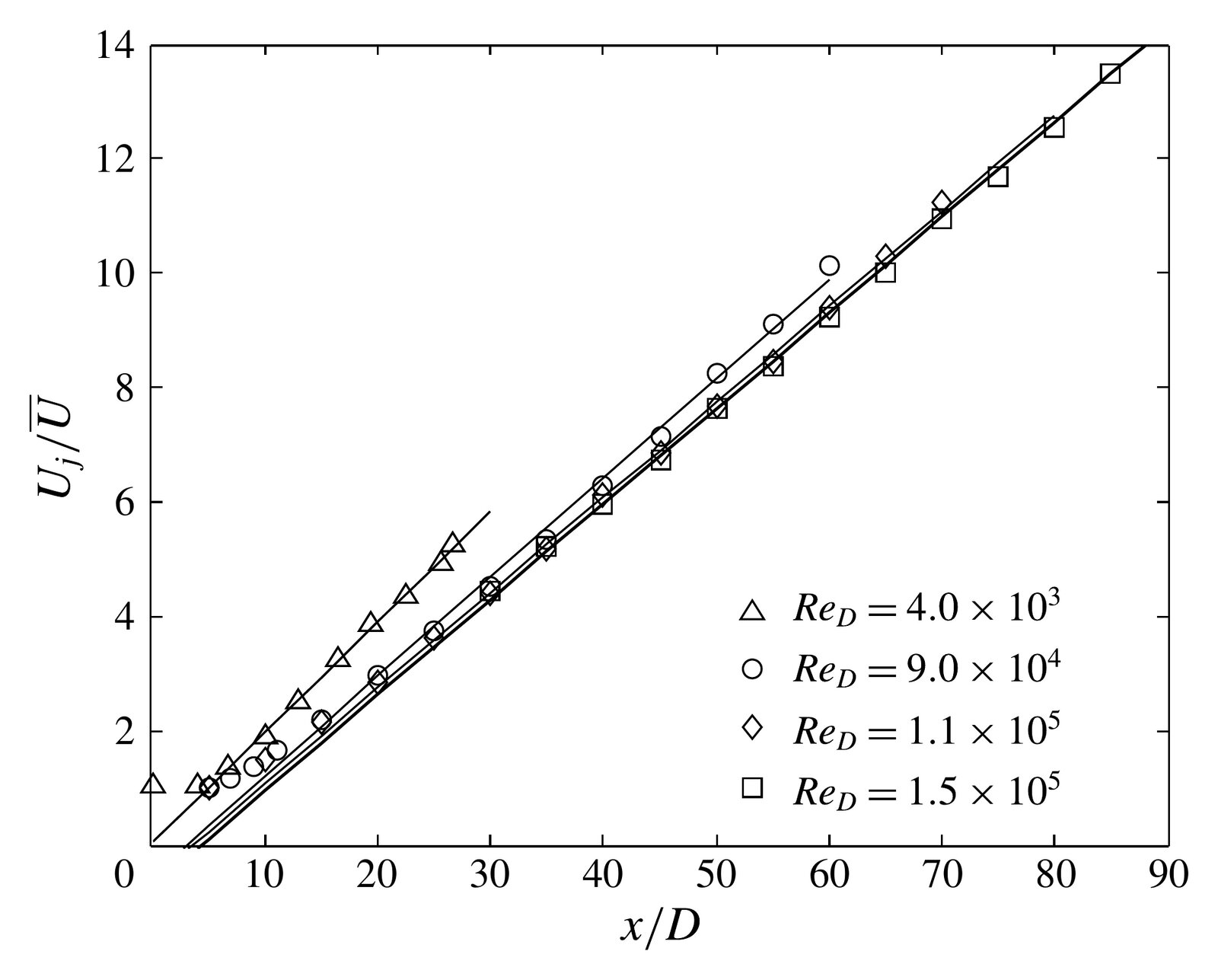
- The mean velocity does follow the x−1 law: Uj/U is linear in x/D, with a virtual origin xo ≈ 4.5D.
The measurements confirm complete self-preservation
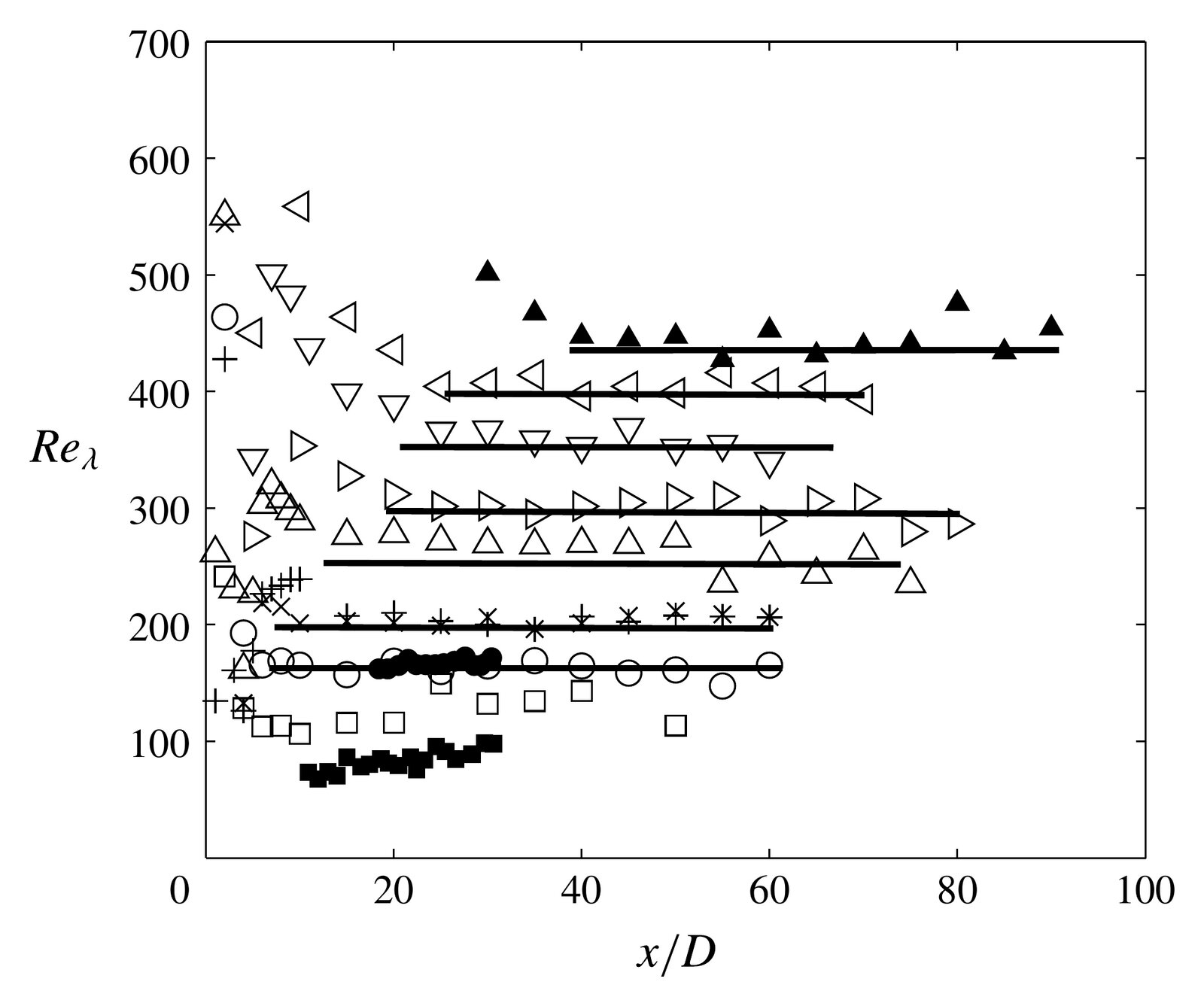
- Reλ reaches a plateau once ReD ≥ 2 × 10⁴. At ReD = 104, it does not settle: self-preservation is not reached.
- The plateau starts further downstream as the Reynolds number increases: around x/D ≈ 15 at ReD = 3.4 × 10⁴, around x/D ≈ 40 at 1.3 × 10⁵. Measurements must therefore be taken far enough from the nozzle.

- The dissipation follows the x−4 law in the far field.
- The prefactor Aε is calculated from the decay of U and the turbulence intensity: about 36, within 8% of the measurement, against 48 for the often-quoted value of Friehe et al. (1971).
- The second- and third-order structure functions measured at different distances collapse once normalised: self-preservation holds at every scale.
Key takeaways
- On the axis of a round jet, self-preservation is enough to recover the decay laws of U, k and ε, with no other equation.
- The measurements confirm it, provided they are taken far enough from the nozzle, and further still as the Reynolds number increases.
- The prefactor formula gives a simple way to estimate ε on the axis, from measurements of mean velocity and turbulence intensity.
Further reading
L. Djenidi, R. A. Antonia, N. Lefeuvre, J. Lemay, Complete self-preservation on the axis of a turbulent round jet, Journal of Fluid Mechanics 790, 57–70 (2016), PDF · DOI
Did you find this article useful?
Rate it from 1 to 5 stars. Anonymous, no sign-up.
Thank you! Your rating: 1 out of 5. You can change it by clicking another star.
Thank you! Your rating: 2 out of 5. You can change it by clicking another star.
Thank you! Your rating: 3 out of 5. You can change it by clicking another star.
Thank you! Your rating: 4 out of 5. You can change it by clicking another star.
Thank you! Your rating: 5 out of 5. You can change it by clicking another star.
Too many ratings sent in a short time. Please try again in an hour.
Your rating could not be saved. Please try again later.
Comments
No comments yet. Be the first to share your thoughts.