 NATHAN LEFEUVRE
Turbulent dissipation: which approximation to choose?
A look back at my Physics of Fluids paper (2014): in the simulated wake of a square cylinder, which approximations of the dissipation are reliable?
In 2014, while at the University of Newcastle (Australia), I published this paper in Physics of Fluids with Fabien Thiesset, Lyazid Djenidi and Robert Antonia. The topic: the turbulent kinetic energy dissipation rate ε, a key quantity in turbulence, and how to estimate it correctly from incomplete measurements.
My contribution: as first author, I developed the LBM code, ran the simulations, then handled the data post-processing and analysis.
Why it is hard
- ε involves 12 velocity derivatives. A simulation gives all of them, but an experiment only provides a few.
- So we use approximations ("surrogates") that assume some properties of the flow:
- εiso, if turbulence is locally isotropic (a single derivative is enough);
- εa,x and εa,y, if it is locally axisymmetric along x or y;
- εhom, if it is locally homogeneous (from the enstrophy);
- ε4x, if it is homogeneous in the transverse plane (10 of the 12 terms, measurable with a 4 X-wire probe).
- Our question: which ones remain reliable, on average but also instant by instant?
The method

- Simulation: I used the lattice Boltzmann method (LBM), with a Smagorinsky model to keep the computation stable near the cylinder.
- Flow: wake of a square cylinder, Reynolds number ReD = 2000. I chose a square cylinder because it gives a more isotropic wake than a circular one and is easy to model.
- Resolution: from 3.5η near the cylinder to 1η at x/D = 100 (η: Kolmogorov scale), comparable to reference direct simulations.
- Validation: I obtain a Strouhal number St = 0.129, close to the measured 0.13, and spectra in agreement with hot-wire measurements and a direct simulation of channel flow.
On average: everything converges far from the cylinder
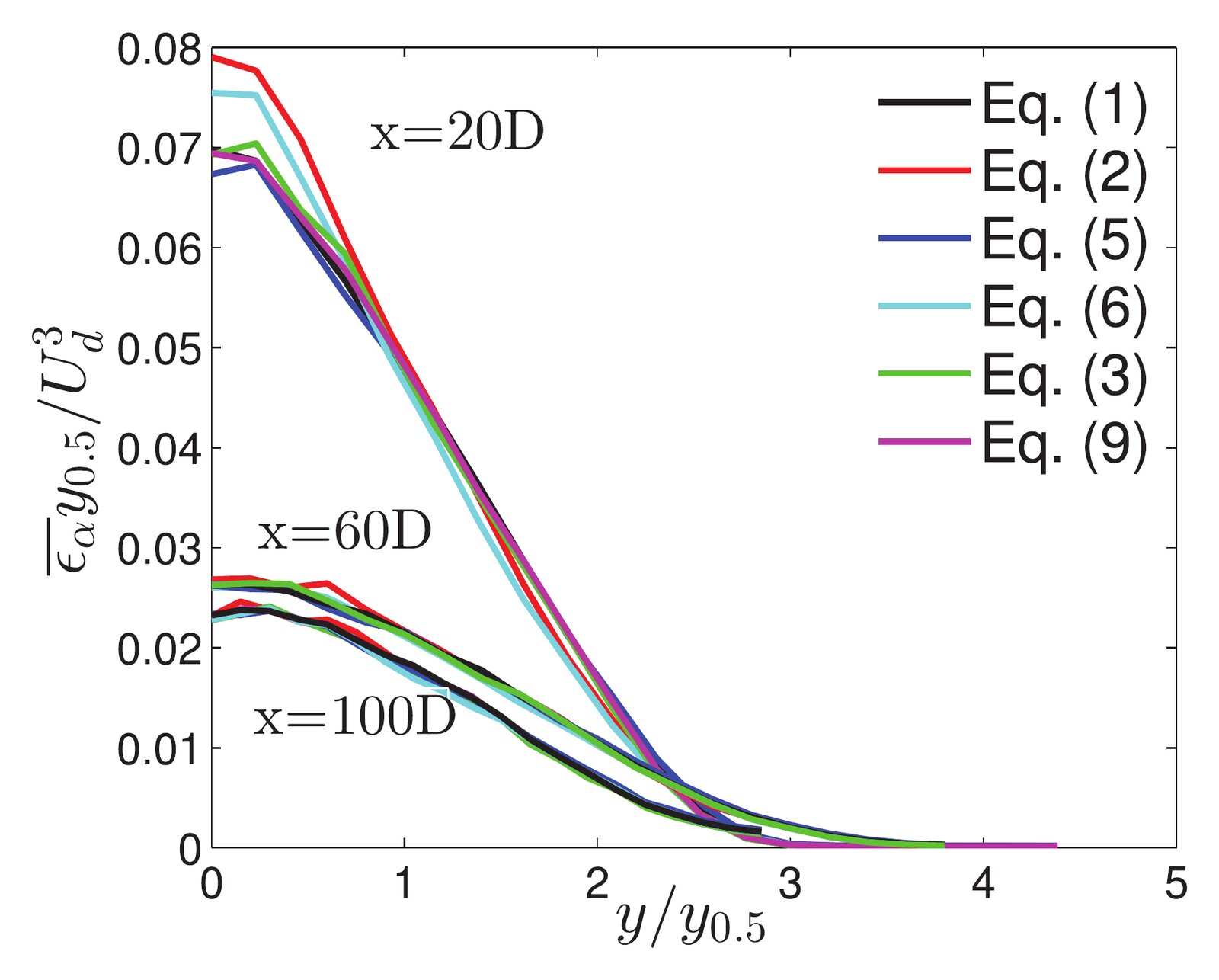
- Beyond about 40 diameters, all approximations give the right mean dissipation.
- Closer (x = 20D), εiso and εa,y clearly depart near the axis, because of the flow anisotropy. εa,x, εhom and ε4x remain correct.
- Notably, εiso works even when isotropy does not hold: the differences between the derivatives compensate each other.
Fluctuations: the isotropic approximation gets it wrong

- The standard deviation of ε is as large as its mean: dissipation fluctuates strongly, as Landau pointed out.
- ε4x reproduces these fluctuations well. εiso overestimates them by almost a factor of 2.
Instant by instant: ε4x stands out

- All probability densities have a nearly exponential tail, but they differ on the most probable values.
- Only the one of ε4x closely follows that of ε.
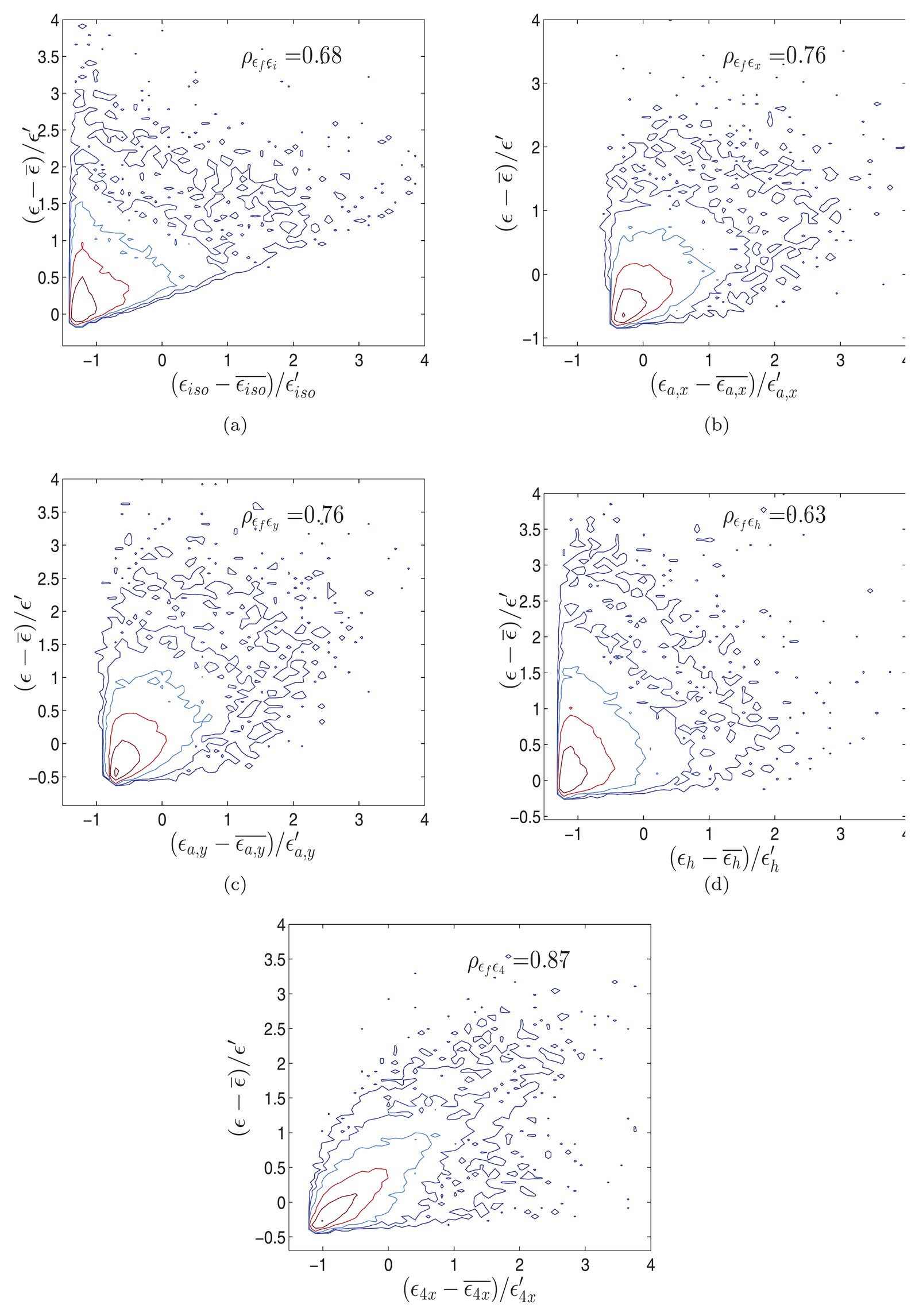
- Correlation coefficients with ε on the axis: 0.87 for ε4x, 0.68 to 0.76 for εiso, εa,x and εa,y, and 0.63 for εhom.
- εhom correlates less well than expected: pressure fluctuations play a significant role in the wake.
Key takeaways
- For the mean dissipation, far from the obstacle, all approximations are suitable.
- For fluctuations and instantaneous values, ε4x is the best surrogate.
- It is a useful result for experimentalists: ε4x can be obtained with a four-wire probe (two X-wires).
Further reading
N. Lefeuvre, F. Thiesset, L. Djenidi, R. A. Antonia, Statistics of the turbulent kinetic energy dissipation rate and its surrogates in a square cylinder wake flow, Physics of Fluids 26, 095104 (2014), PDF · DOI
Did you find this article useful?
Rate it from 1 to 5 stars. Anonymous, no sign-up.
Thank you! Your rating: 1 out of 5. You can change it by clicking another star.
Thank you! Your rating: 2 out of 5. You can change it by clicking another star.
Thank you! Your rating: 3 out of 5. You can change it by clicking another star.
Thank you! Your rating: 4 out of 5. You can change it by clicking another star.
Thank you! Your rating: 5 out of 5. You can change it by clicking another star.
Too many ratings sent in a short time. Please try again in an hour.
Your rating could not be saved. Please try again later.
Comments
No comments yet. Be the first to share your thoughts.