 NATHAN LEFEUVRE
Is the Cε parameter universal? What self-preservation tells us
A look back at our Journal of Fluid Mechanics paper (2017): when does the normalised dissipation Cε stay constant in decaying turbulence?
In 2017, I co-authored this Journal of Fluid Mechanics paper with Lyazid Djenidi, M. Kamruzzaman and Robert Antonia (University of Newcastle, Australia). The topic: the normalised dissipation parameter Cε = εL/u'3, and whether it is a universal constant of turbulence.
My contribution: automating the laboratory's round jet (LabVIEW, Matlab), the hot-wire measurements along its axis, then the data post-processing and analysis.
Why it matters
- The dissipation ε is almost impossible to measure directly in the field (atmosphere, ocean, industrial processes): it requires 12 velocity derivatives.
- If Cε is constant, measuring the turbulence intensity u' and the integral scale L, two easy quantities, is enough to deduce ε.
- This constancy is often taken for granted, on dimensional grounds. Yet Taylor (1935) and Kolmogorov (1941) assumed it in a specific setting: a self-preserving flow, whose statistics keep the same shape as it decays.
The method
- Theory: we start from the Navier–Stokes equations, through the scale-by-scale energy budget, with no closure model, and impose self-preservation.
- Two decaying flows: grid turbulence, close to homogeneous isotropic turbulence but not self-preserving, and the far-field axis of a round jet, locally isotropic and self-preserving.
- Measurements: three grids (two perforated plates, one woven mesh) in a wind tunnel and the round jet, which I measured at three Reynolds numbers, complemented by published data (fractal grids, plane jet, direct numerical simulations).
In the jet, Cε stays constant; behind a grid, it decreases

- The theory shows that if turbulence decays while remaining self-preserving, Cε stays constant for a given initial condition.
- On the jet axis, which is self-preserving, Cε is indeed nearly constant after a development stage.
- Behind the grids, which are not, Cε decreases with distance. The constancy of Cε requires self-preservation, not the other way round.
As the Reynolds number increases, Cε tends to a limit

- The ratio of the integral scale to the Taylor microscale, Lu/λ, grows roughly linearly with the Reynolds number Reλ, whatever the flow.
- With the relation Cε = 15 (L/λ)/Reλ, we deduce that Cε decreases towards a limiting value Cε,∞.
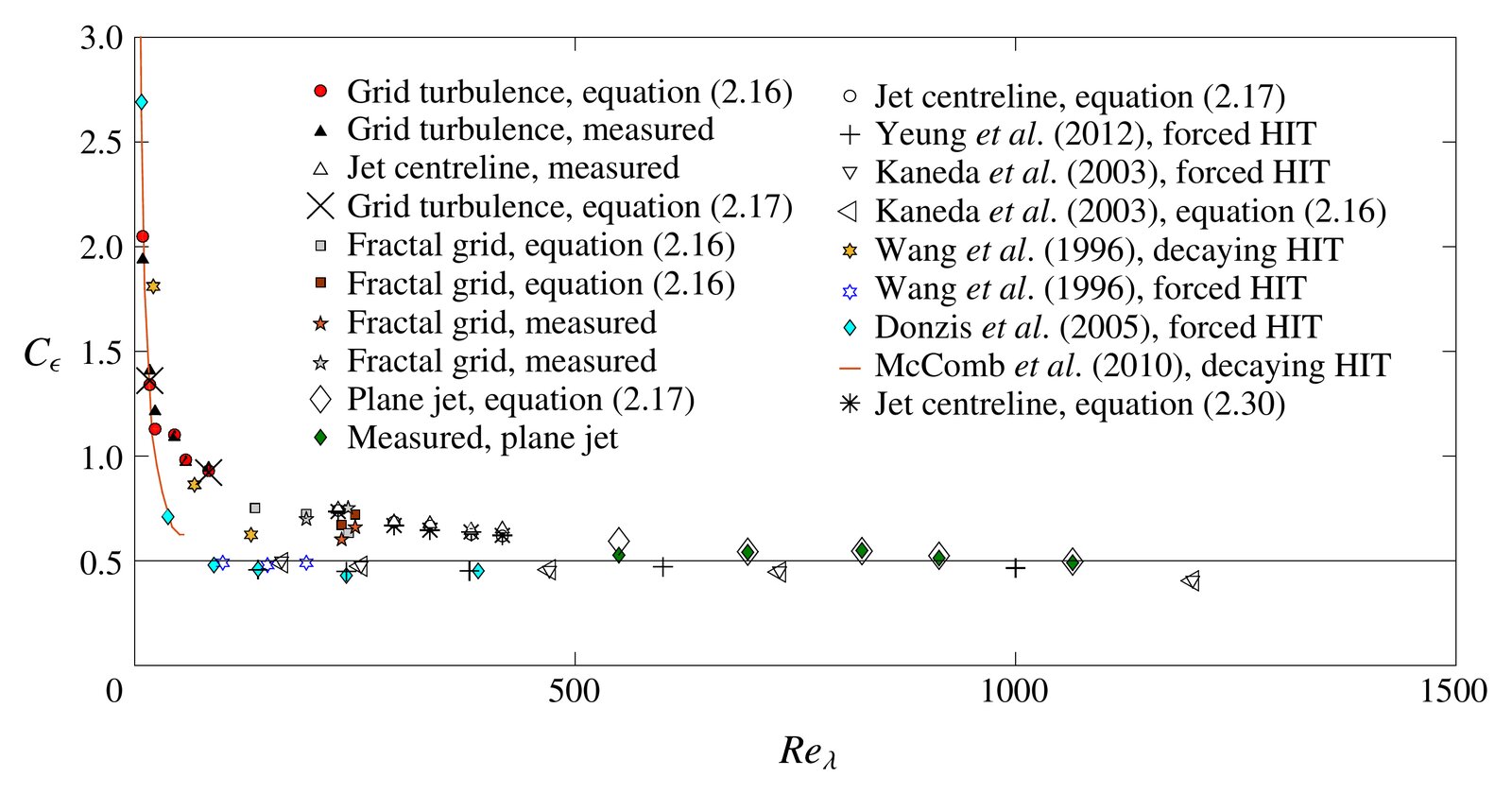
- Measurements and theory agree for each flow.
- At high Reynolds numbers, the values for decaying flows join those of forced turbulence, around 0.5.
- The limit still seems to depend on the flow, but a universal constant cannot be ruled out.
Key takeaways
- The constancy of Cε during decay stems from self-preservation: it holds in the round jet, not behind a grid.
- Cε decreases as the Reynolds number increases, towards a value close to 0.5, possibly universal.
- To estimate ε from u' and L, my takeaway is that you must check that the flow is self-preserving and that its Reynolds number is high.
Further reading
L. Djenidi, N. Lefeuvre, M. Kamruzzaman, R. A. Antonia, On the normalized dissipation parameter Cε in decaying turbulence, Journal of Fluid Mechanics 817, 61–79 (2017), PDF · DOI
Did you find this article useful?
Rate it from 1 to 5 stars. Anonymous, no sign-up.
Thank you! Your rating: 1 out of 5. You can change it by clicking another star.
Thank you! Your rating: 2 out of 5. You can change it by clicking another star.
Thank you! Your rating: 3 out of 5. You can change it by clicking another star.
Thank you! Your rating: 4 out of 5. You can change it by clicking another star.
Thank you! Your rating: 5 out of 5. You can change it by clicking another star.
Too many ratings sent in a short time. Please try again in an hour.
Your rating could not be saved. Please try again later.
Comments
No comments yet. Be the first to share your thoughts.