 NATHAN LEFEUVRE
Far wake of a square cylinder: a two-term energy budget
A look back at our FSSIC paper: far behind a square cylinder, the turbulent energy brought in by advection is dissipated almost on the spot.
In 2015, I co-authored this paper with S. L. Tang, Lyazid Djenidi, Robert Antonia (University of Newcastle, Australia) and Yu Zhou (Harbin Institute of Technology, Shenzhen, China) for the FSSIC (Fluid-Structure-Sound Interactions and Control) conference in Perth. The topic: measuring, term by term, the turbulent kinetic energy budget in the far wake of a square cylinder, and comparing it with that of a circular cylinder.
My contribution: my LBM simulations of the intermediate wake, where advection already balanced dissipation and which prompted the study, then the comparison with the circular cylinder wake and the data analysis.
Why this budget
- In a plane wake, the turbulent energy q2 changes under four terms: advection by the mean flow, production by shear, diffusion (turbulent and by pressure) and dissipation ε.
- Behind a circular cylinder, on the axis, three terms matter: advection, dissipation and diffusion, the latter being of the same order as advection.
- Behind a square cylinder, nobody had yet measured this budget in the far field. My simulations of the intermediate wake, up to x/d = 100, showed that advection balances dissipation there.
- Our question: does this two-term budget hold in the far field, and is the isotropic approximation εiso enough to estimate the dissipation there?
The method
- Wind tunnel: an open-return, low-turbulence wind tunnel with a 2.2 m long working section, 0.35 m × 0.35 m in cross-section.
- Flow: a square cylinder of side d = 6.3 mm and a free-stream velocity of 9.5 m/s, giving a Reynolds number of 4000. Measurements are taken at x/d = 230 and 270.
- Measurements: an X-wire probe (2.5 µm Wollaston wires), constant-temperature anemometers, filtering close to the Kolmogorov frequency, and 12-bit acquisition at 20 kHz for about 100 s.
- Budget: the dissipation is estimated from its isotropic form εiso = 15ν(∂u/∂x)2, and pressure diffusion is obtained by difference.
The far wake is self-preserving

- The profiles collapse once normalised by the maximum velocity defect and the wake half-width, and match those of Zhou and Antonia for the same obstacle.
- A slight difference in the shear stress, between y* = 1 and 1.5, is probably due to different initial conditions.
- Self-preservation is a valuable starting point: it opens the way to a theoretical analysis of the far wake.
On the axis, advection offsets dissipation
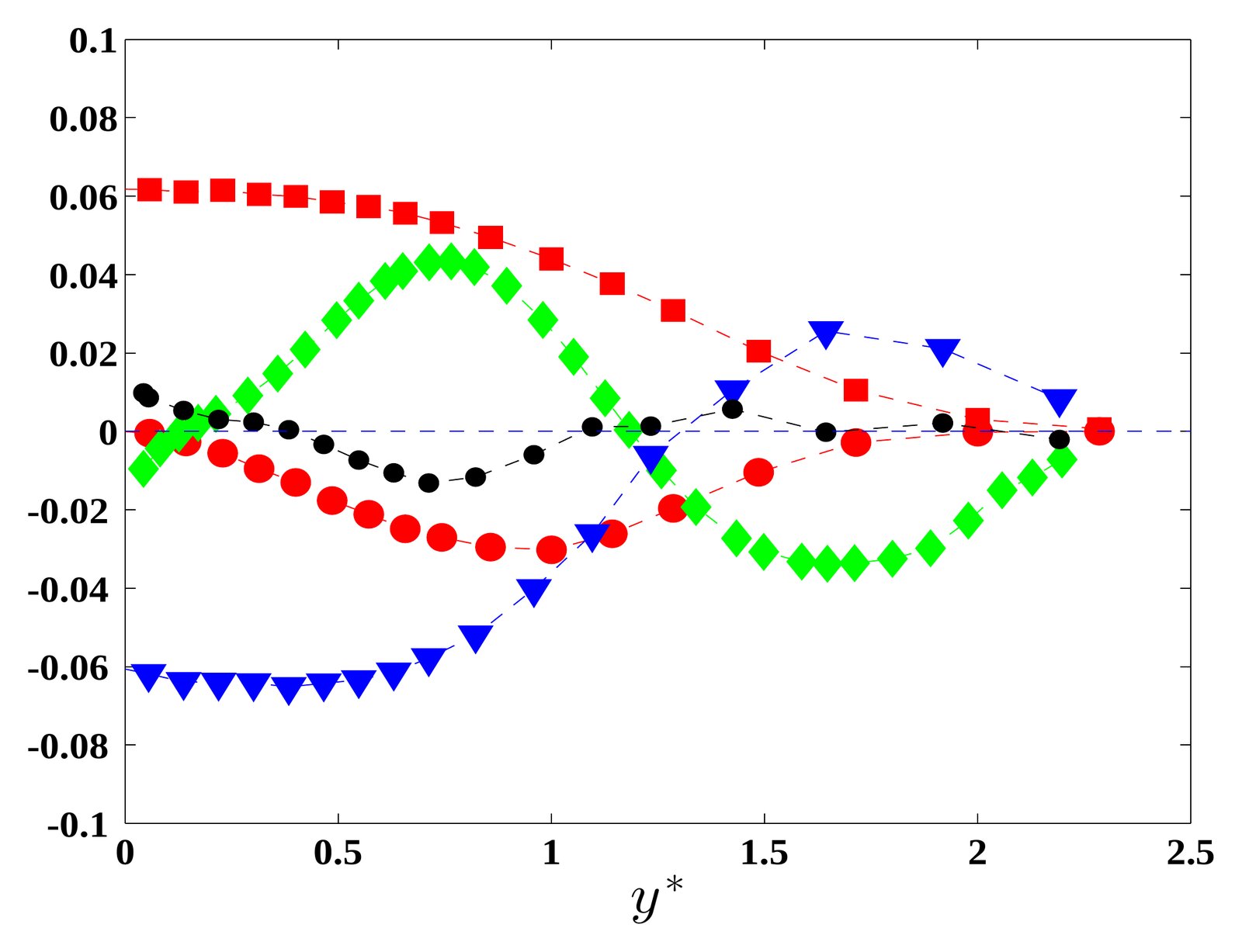
- Near the axis (y* < 0.3), the energy gained through advection is roughly equal to the energy lost through dissipation.
- q2 diffusion is negligible: about 1/7 of advection on the axis, against a ratio close to 1 behind a circular cylinder. The way energy is transported therefore differs from one obstacle to the other.
Away from the axis, diffusion takes over
- Moving away from the axis, diffusion and production rise quickly and weigh clearly in the budget.
- At the edge of the wake (y* from 1.6 to 2.5), production and dissipation become negligible: diffusion and advection balance each other.
- Pressure diffusion stays small, and both diffusion terms satisfy their integral constraint. εiso is therefore a good surrogate for the dissipation, as in the intermediate wake.
Key takeaways
- In the far wake of a square cylinder, the energy budget on the axis comes down to two terms: advection and dissipation.
- This is a real difference from the circular cylinder, where diffusion counts as much as advection.
- The isotropic approximation εiso, available from a single hot wire, is enough to estimate the mean dissipation in this wake.
Further reading
S. L. Tang, N. Lefeuvre, L. Djenidi, R. A. Antonia, Y. Zhou, Turbulent kinetic energy budget in the far field of a square cylinder wake, 3rd Symposium on Fluid-Structure-Sound Interactions and Control (FSSIC3), Perth (2015), PDF
Did you find this article useful?
Rate it from 1 to 5 stars. Anonymous, no sign-up.
Thank you! Your rating: 1 out of 5. You can change it by clicking another star.
Thank you! Your rating: 2 out of 5. You can change it by clicking another star.
Thank you! Your rating: 3 out of 5. You can change it by clicking another star.
Thank you! Your rating: 4 out of 5. You can change it by clicking another star.
Thank you! Your rating: 5 out of 5. You can change it by clicking another star.
Too many ratings sent in a short time. Please try again in an hour.
Your rating could not be saved. Please try again later.
Comments
No comments yet. Be the first to share your thoughts.